Complete Guide to Eligibility, Registration, 8171 Check, Payments & Latest Updates
The Benazir Income Support Programme (BISP) is Pakistan’s largest social protection initiative created to help financially vulnerable families. Since its launch in 2008, millions of deserving households have received financial assistance through different welfare programs. Today, BISP continues to expand with improved technology, digital payment systems, updated eligibility criteria, and better transparency to ensure assistance reaches deserving beneficiaries.
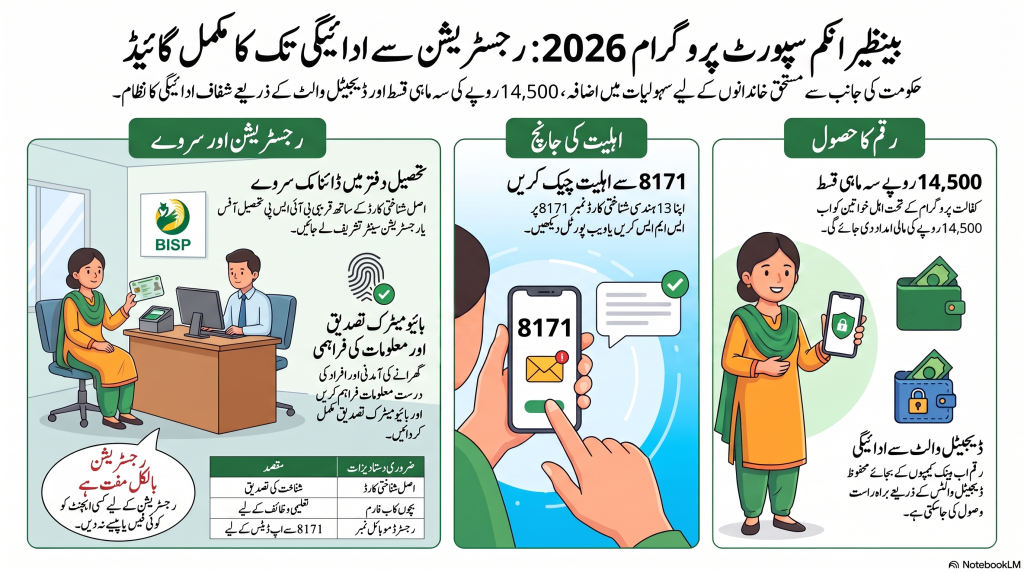
In 2026, the Government of Pakistan has introduced several improvements to the programme. These include increased quarterly payments, expansion of Dynamic Registration Centers, new digital wallet-based payments, and wider use of the National Socio-Economic Registry (NSER) to identify deserving households. Families can now check eligibility using the official 8171 portal or SMS service without visiting offices repeatedly. These improvements are designed to reduce delays, prevent fraud, and make the process easier for applicants across Pakistan. According to official government updates, BISP now supports millions of households nationwide while continuing to strengthen social protection through Kafaalat, Taleemi Wazaif, Nashonuma, and other welfare initiatives.
What is the Benazir Income Support Programme?
The Benazir Income Support Programme is a federal cash assistance programme managed by the Government of Pakistan. Its primary objective is to reduce poverty by providing regular financial support to low-income families, especially women. The programme focuses on empowering women because payments are generally issued in the name of eligible female family members.
BISP is much more than a cash transfer programme. It also supports children’s education through Benazir Taleemi Wazaif, maternal and child health through Benazir Nashonuma, and several financial inclusion initiatives. The government continues to improve beneficiary identification using the NSER database and Dynamic Surveys. Families who qualify receive quarterly financial assistance after successful verification. This structured approach helps ensure that limited public resources reach those who genuinely need financial support while maintaining transparency through digital verification systems.
Latest BISP 2026 Updates
The year 2026 has brought several important changes for BISP beneficiaries. One of the biggest updates is the increase in the Benazir Kafaalat quarterly payment to Rs. 14,500. Government officials have also announced plans for a further increase beginning in 2027.
Another major reform is the nationwide rollout of digital wallet payments. Instead of relying entirely on payment camps, beneficiaries will gradually receive funds directly through secure digital wallets linked with the programme. This initiative is expected to reduce unauthorized deductions and improve transparency. The government has also expanded Dynamic Registration Centers and mobile registration vans to make registration easier in remote areas. These improvements reflect the government’s continued focus on modernizing Pakistan’s largest social protection programme.
Who is Eligible for BISP in 2026?
Eligibility is one of the most important parts of the Benazir Income Support Programme because financial assistance is meant only for families that genuinely need support. The government uses the National Socio-Economic Registry (NSER) and a Proxy Means Test (PMT) to determine whether an applicant qualifies. During the Dynamic Survey, officials collect information about your household size, monthly income, employment status, education level, property ownership, and living conditions. This data is carefully reviewed before a final decision is made. If your household meets the required criteria, your information is added to the list of eligible beneficiaries, and you can receive quarterly financial assistance under the Benazir Kafaalat Programme.
While the exact PMT score can vary depending on government policy and special categories, families with low incomes, widows, divorced women, persons with disabilities, and households without stable sources of income generally have a higher chance of qualifying. Applicants should ensure that all information provided during the survey is accurate because false or incomplete information may lead to rejection or removal from the programme. The government also conducts regular verification to identify households whose financial condition has improved, ensuring that assistance continues to reach deserving families. If your application is rejected, you can visit your nearest BISP Tehsil Office for guidance and request a fresh Dynamic Survey if your circumstances have changed.
PMT Score Criteria
The Proxy Means Test (PMT) score is a numerical value assigned to every household after evaluating its socio-economic condition. Instead of relying only on income, the PMT system examines several indicators, including family size, housing quality, employment status, assets, education, and access to basic facilities. A lower PMT score generally indicates greater financial vulnerability, making the household more likely to qualify for BISP assistance.
The government periodically reviews PMT score thresholds to reflect changing economic conditions and inflation. Applicants should remember that simply having a low income does not automatically guarantee eligibility. Other factors, such as ownership of expensive property, frequent international travel, high electricity consumption, or employment in government service, may affect eligibility. Therefore, families are encouraged to complete the Dynamic Survey honestly and update their information whenever significant changes occur.
NSER Dynamic Survey
The NSER Dynamic Survey is the official method used to register new applicants and update the records of existing beneficiaries. Unlike earlier registration campaigns that were conducted only once, the Dynamic Survey allows eligible families to update their information whenever required. This makes the programme more flexible and ensures that deserving households are not left behind because of outdated records.
During the survey, applicants are asked questions about their family members, educational background, employment, monthly income, disabilities, and living conditions. Biometric verification and identity confirmation through the NADRA database help prevent duplicate registrations and fraudulent claims. Once the survey is completed, the collected information is processed, and eligible families receive confirmation through the official 8171 SMS service or the online eligibility portal.
Required Documents for BISP Registration
Before visiting a BISP Dynamic Registration Center, applicants should prepare all required documents to avoid unnecessary delays. Having complete and accurate documentation helps officials verify your information quickly and improves the chances of successful registration. Most applicants only need a few basic documents, but additional papers may be required depending on individual circumstances.
| Required Document | Purpose |
|---|---|
| Original Computerized National Identity Card (CNIC) | Identity verification |
| Registered mobile number | SMS notifications and updates |
| Children’s B-Form (if applying for Taleemi Wazaif) | Child verification |
| Disability certificate (if applicable) | Special eligibility category |
| Death certificate of husband (for widows) | Widow verification |
| Utility bill (if requested) | Address verification |
Applicants should always carry the original documents rather than photocopies unless specifically requested. If any information on your CNIC has changed, such as your address or marital status, it is recommended to update your NADRA record before visiting the registration center. This helps prevent delays during verification and ensures your information matches the national database.
How to Register for the Benazir Income Support Programme
The registration process for BISP has become much simpler over the past few years. Instead of relying on online forms that are often confused with unofficial websites, the government requires new applicants to complete the Dynamic Survey at designated BISP Tehsil Offices or Dynamic Registration Centers. This in-person process allows officials to verify identity, collect socio-economic data, and complete biometric authentication in a secure environment.
When you arrive at the registration center, a BISP representative will first verify your CNIC. After identity verification, your household information will be entered into the NSER system. You will then answer questions regarding your income, employment, education, housing conditions, and family members. Once all information has been recorded, biometric verification is completed, and you receive a registration slip for future reference. The collected data is then reviewed, and if your household qualifies, you will receive an SMS from 8171 confirming your eligibility.
Registration at Dynamic Registration Centers
Dynamic Registration Centers are available in almost every district of Pakistan. These centers are specifically designed to provide registration services, update beneficiary information, and resolve complaints. Unlike earlier registration campaigns that operated for limited periods, Dynamic Registration Centers remain open throughout the year, making it easier for families to register whenever necessary.
Applicants should visit only official BISP offices and avoid individuals claiming they can arrange registration in exchange for money. Registration is completely free of charge, and no agent is authorized to collect any fee. If someone demands payment for registration or promises guaranteed approval, applicants should immediately report the incident to BISP authorities through the official complaint channels.
Important Registration Tips
Although the registration process is straightforward, following a few simple guidelines can help avoid unnecessary complications. Applicants should carefully review all information before submitting it because incorrect details may delay verification. It is also important to keep your registered mobile number active since all official updates are sent through SMS from 8171.
Here are a few useful recommendations:
- Visit only official BISP Tehsil Offices or Dynamic Registration Centers.
- Never pay anyone for registration or eligibility verification.
- Keep your CNIC updated with NADRA.
- Provide accurate household information during the Dynamic Survey.
- Save your registration receipt until your application is processed.
- Ignore unofficial SMS messages or fake websites claiming instant approval.
Following these steps can significantly reduce the chances of delays and help ensure a smooth registration experience.
How to Check BISP Status Through 8171
After completing the registration process, the next step is checking your eligibility and payment status. The Government of Pakistan has made this process much easier through the 8171 SMS service and the 8171 web portal. These official services allow applicants to verify whether they qualify for financial assistance without repeatedly visiting a BISP office. This saves both time and travel expenses, especially for families living in remote areas. Whether you have recently completed the Dynamic Survey or you are already a beneficiary, checking your status regularly helps you stay informed about payment releases, survey updates, and eligibility verification.
To check your status through SMS, simply type your 13-digit CNIC number without spaces or dashes and send it to 8171 using your registered mobile number. Within a short time, you will receive a reply indicating whether you are eligible, under verification, or required to update your information. If you prefer using the internet, you can visit the official 8171 web portal, enter your CNIC along with the verification code displayed on the screen, and view your latest application or payment status. Always use the official government portal and avoid third-party websites that ask for personal information or registration fees. The government repeatedly reminds applicants that BISP services are completely free, and no agent or private website can speed up the approval process.
How to Receive BISP Payments
Once your application is approved, you become eligible to receive quarterly financial assistance under the Benazir Kafaalat Programme. The government has introduced several payment methods to make the distribution process more transparent and secure. Beneficiaries are informed through the official 8171 SMS service whenever a new payment installment is released. It is important not to visit payment centers until you receive the official notification because payments are released in phases across different districts.
Traditionally, beneficiaries collected payments from designated BISP campsites or authorized banking partners after completing biometric verification. In 2026, the government has started expanding digital wallet payments, allowing eligible women to receive funds directly through secure digital financial services. This modernization reduces long queues, minimizes unauthorized deductions, and provides greater convenience for beneficiaries. Regardless of the payment method, recipients should always verify the amount received and request a printed receipt whenever available. If any deduction is made without authorization, it should be reported immediately to the nearest BISP office or through the official complaint system.
Major Programmes Under BISP
The Benazir Income Support Programme is no longer limited to quarterly cash assistance. Over the years, it has evolved into a comprehensive social protection system that supports women, children, and vulnerable households in several different ways. These initiatives are designed to reduce poverty while encouraging education, improving nutrition, and promoting financial inclusion. Each programme has its own eligibility requirements, but together they provide a stronger safety net for deserving families across Pakistan.
Today, the three most recognized initiatives under BISP are Benazir Kafaalat, Benazir Taleemi Wazaif, and Benazir Nashonuma. Families that qualify for the Kafaalat Programme may also become eligible for additional benefits if they meet the specific conditions of these supporting programmes. This integrated approach ensures that financial assistance is combined with long-term investments in education and health rather than simply providing temporary cash support.
Benazir Kafaalat Programme
The Benazir Kafaalat Programme is the flagship component of BISP and provides quarterly financial assistance to eligible women from low-income households. The programme is specifically designed to strengthen women’s financial independence by transferring payments directly to registered female beneficiaries. By placing financial resources in the hands of women, the programme aims to improve household welfare, children’s education, and family nutrition.
Beneficiaries are selected through the NSER Dynamic Survey and biometric verification. Once approved, they receive quarterly installments according to the government’s payment schedule. Payments are released only after successful identity verification to prevent fraud and duplicate claims. Beneficiaries are encouraged to keep their personal information updated so they continue receiving assistance without interruption.
Benazir Taleemi Wazaif
Education is one of the strongest tools for breaking the cycle of poverty. The Benazir Taleemi Wazaif Programme provides additional financial support to families whose children regularly attend school. This initiative encourages parents to keep their children enrolled in educational institutions by offering education stipends alongside the regular Kafaalat payments.
To qualify, children must be enrolled in a recognized school and maintain the required attendance percentage set by the programme. Parents are required to submit the child’s B-Form issued by NADRA during registration. School attendance is monitored periodically, and continued eligibility depends on meeting attendance requirements. Through this programme, thousands of children have been able to continue their education despite financial hardships faced by their families.
Benazir Nashonuma Programme
The Benazir Nashonuma Programme focuses on improving the health and nutrition of pregnant women, breastfeeding mothers, and young children. Malnutrition remains a serious challenge in many parts of Pakistan, particularly among low-income families. This programme addresses that issue by providing nutritional support, health education, and conditional financial assistance to eligible beneficiaries.
Pregnant women and mothers are encouraged to attend regular health checkups at participating health facilities. Children receive nutritional monitoring during their early developmental years to reduce the risk of stunting and other health complications. By combining financial support with healthcare services, the programme helps improve maternal health while giving children a healthier start in life.
Common Reasons Why BISP Applications Are Rejected
Although thousands of families successfully register every year, some applications are rejected because they fail to meet the programme’s eligibility requirements or contain inaccurate information. Understanding these common reasons can help applicants avoid unnecessary delays and improve their chances of approval. The most frequent issue is outdated or incorrect information in the NSER database. If your household details have changed but were never updated, the system may assess your eligibility using old information.
Other common reasons include ownership of valuable assets, government employment, high utility consumption, foreign travel records, or incomplete documentation during registration. Some applicants also fail biometric verification because their fingerprints cannot be matched correctly with NADRA records. If your application is rejected, do not assume the decision is final. Visit your nearest BISP Tehsil Office, verify the reason for rejection, and request an updated Dynamic Survey if your financial circumstances have changed. Many applicants become eligible after correcting inaccurate records or completing the required verification process.
How to Protect Yourself from BISP Fraud
As BISP has expanded, scammers have also become more active by sending fake SMS messages, making fraudulent phone calls, and creating unofficial websites that claim to offer guaranteed registration or faster payments. These scams target vulnerable families who may not be familiar with the official registration process. The government repeatedly warns beneficiaries that BISP never charges any registration fee, and all official communication is sent only through 8171 or authorized BISP offices.
If someone asks for money in exchange for registration, payment release, or eligibility confirmation, you should refuse immediately and report the incident. Never share your CNIC number, biometric information, bank details, or one-time verification codes with unknown individuals. Always verify information through the official BISP website, the 8171 SMS service, or your nearest BISP Tehsil Office. Staying alert and relying only on official communication channels is the best way to protect yourself from fraud and ensure your benefits remain secure.