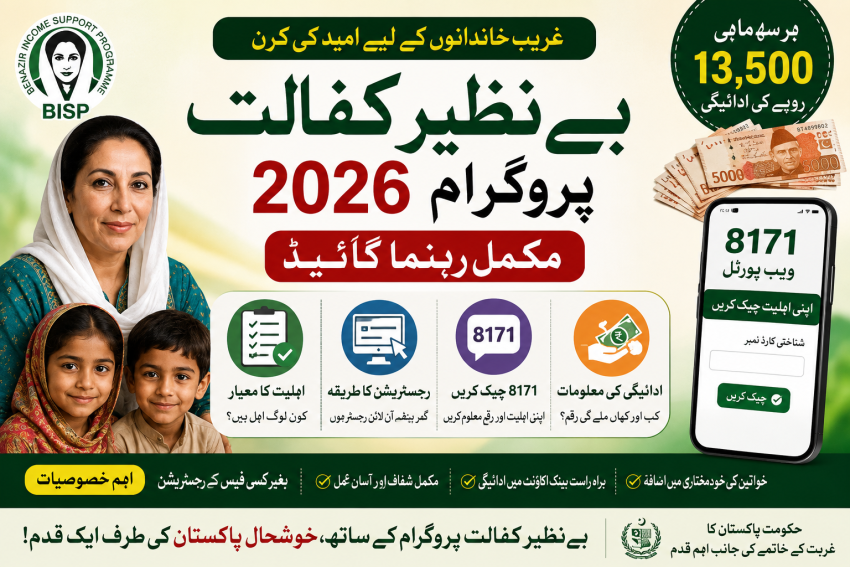
Benazir Kafaalat Programme 2026: Complete Guide to Registration, Eligibility, 8171 Check & Latest Payments
The Benazir Kafaalat Programme is the flagship cash assistance initiative under the Benazir Income Support Programme (BISP). It provides quarterly financial support to deserving women from low-income households across Pakistan. Since its launch, the programme has become the country’s largest unconditional cash transfer initiative, helping millions of families manage daily household expenses during periods of rising inflation and economic hardship. Its primary objective is not only to reduce poverty but also to empower women by making them the direct recipients of financial assistance.
In 2026, the programme continues to expand with larger financial allocations, improved payment systems, and stronger transparency measures. The Government of Pakistan has increased the quarterly payment to Rs. 14,500 for eligible beneficiaries while continuing to improve registration through the National Socio-Economic Registry (NSER). Official figures show that nearly 12 million households are currently benefiting from the programme, making it one of the largest social protection initiatives in South Asia. Officials have also announced plans to increase the quarterly stipend to Rs. 18,000 from January 2027, subject to implementation.
What Are the Latest Updates in the Benazir Kafaalat Programme for 2026?
The Benazir Kafaalat Programme has received several important improvements in 2026 to make financial assistance more accessible, transparent, and efficient for deserving families. The Government of Pakistan has increased the quarterly financial assistance to Rs. 14,500 for eligible beneficiaries. At the same time, the federal budget allocation for the Benazir Income Support Programme (BISP) has been increased to strengthen social protection and expand coverage for low-income households. Official announcements indicate that nearly 12 million families are benefiting from the programme, making it one of the largest cash assistance initiatives in Pakistan.
The government is also modernizing the payment system through digital wallets and improved banking services. Beneficiaries in selected districts can now receive payments through secure digital channels instead of relying solely on payment camps. This change is expected to reduce waiting times, eliminate unauthorized deductions, and provide women with greater control over their financial assistance. Alongside payment reforms, Dynamic Registration Centers continue to operate across Pakistan, allowing new applicants to register and existing beneficiaries to update their household information whenever required. These improvements demonstrate the government’s commitment to making the programme more transparent and easier to access.
New Quarterly Payment
One of the biggest announcements for 2026 is the increase in the Benazir Kafaalat quarterly installment to Rs. 14,500. This increase was introduced to help low-income families cope with rising living costs and inflation. Beneficiaries who complete all required verification procedures can receive the updated payment through authorized payment centers, partner banks, or digital payment channels depending on their district. The increased amount allows families to spend more on food, healthcare, children’s education, and other daily necessities without placing additional financial pressure on already limited household incomes.
Budget Expansion and Beneficiaries
The Government of Pakistan has significantly increased funding for BISP in the 2025-26 federal budget, enabling wider programme coverage and improved service delivery. With this expanded budget, BISP continues to support approximately 12 million deserving households across the country. Government officials have also indicated plans to increase the quarterly Kafaalat payment to Rs. 18,000 from January 2027, subject to implementation. These policy decisions reflect the government’s long-term strategy of strengthening Pakistan’s social safety net while improving financial inclusion for women.
Eligibility Criteria for the Benazir Kafaalat Programme
The Benazir Kafaalat Program is intended especially for low-income families in need of government assistance. The Proxy Means Test (PMT) is used by the National Socio-Economic Registry (NSER) to evaluate eligibility. The approach looks at a number of socioeconomic factors, such as:
- Household size,
- Education level,
- Housing circumstances,
- Employment status,
- Assets, and
- General financial well-being, in addition to income.
This strategy makes it more likely that families who are truly struggling financially would receive aid rather than those who only report having a reduced income.
The program’s biggest beneficiaries are still women. If they meet the necessary qualifying requirements, widows, divorced women, people with disabilities, and households led by women are frequently given preference.
What Candidate Should Have to Apply?
- Candidates must fill out the Dynamic Survey at an approved BISP Registration Center and
- Have a valid Computerized National Identity Card (CNIC) from NADRA.
This Scheme is not for:
The program’s qualifying requirements may prevent families with:
- Government employment,
- Substantial company assets,
- Pricey houses, or
- Regular international travel from becoming eligible.
Frequent verification keeps public funds from being misused while ensuring that financial aid continues to reach worthy households.
PMT Score Requirements
The Proxy Means Test (PMT) is the backbone of the eligibility assessment process. Every registered household receives a poverty score after completing the NSER Dynamic Survey. A lower score generally reflects greater financial vulnerability, increasing the likelihood of qualifying for the Benazir Kafaalat Programme. The government periodically reviews PMT thresholds to reflect changes in economic conditions, inflation, and poverty indicators. Applicants should always provide accurate information because false declarations may result in disqualification or removal from the programme.
NSER Dynamic Survey
Both new applicants and current recipients can register or update their household information through the NSER Dynamic Survey. Officials gather information on family members, employment, education, disability, monthly income, and housing conditions during the survey. NADRA record matching and biometric verification aid in reducing fraud and getting rid of duplicate registrations. To guarantee that their eligibility is evaluated using the most recent data, applicants whose financial situation has changed are urged to fill out a new Dynamic Survey.
Required Documents for Benazir Kafaalat Programme Registration
Preparing the correct documents before visiting a BISP Tehsil Office can save both time and effort. Although the registration process is simple, incomplete documentation is one of the most common reasons applications remain pending. Every applicant should ensure that their identity records are updated with NADRA before beginning the registration process. If there is a mismatch between your CNIC information and the data available in the National Socio-Economic Registry (NSER), your application may require additional verification.
Most applicants only need a few essential documents. However, widows, persons with disabilities, and parents applying for education stipends under Benazir Taleemi Wazaif may need to provide extra supporting documents. Carrying original documents is always recommended because BISP officials verify information directly through government databases during registration.
| Required Document | Purpose |
|---|---|
| Original Computerized National Identity Card (CNIC) | Identity verification |
| Registered mobile phone number | Receiving 8171 SMS updates |
| Children’s B-Form (if applicable) | Taleemi Wazaif registration |
| Disability certificate (if applicable) | Special eligibility verification |
| Husband’s death certificate (for widows) | Widow category verification |
| Updated NADRA family record (if requested) | Household verification |
Applicants should never submit fake or altered documents. BISP uses biometric verification and cross-checks information with NADRA and other government databases. Providing incorrect information can lead to immediate rejection and may affect future eligibility. Keeping your mobile number active is equally important because official payment notifications and eligibility updates are sent through the 8171 SMS service.
How to Register for the Benazir Kafaalat Programme
The Government of Pakistan has made the registration process more organized through Dynamic Registration Centers established in districts across the country. Unlike many unofficial websites that falsely claim to offer online registration, new applicants must complete the registration process in person at an authorized BISP office. This ensures accurate data collection and prevents fraudulent applications. Registration remains completely free, and no government representative is authorized to charge any fee.
When you visit a registration center, officials first verify your CNIC and confirm your identity through biometric authentication. After successful verification, they conduct the NSER Dynamic Survey, asking questions about your household income, family members, employment status, education, housing conditions, and assets. Once all information is entered into the system, you receive a confirmation slip that should be kept safely until your application is processed. The collected data is then reviewed centrally, and eligible applicants receive confirmation through the official 8171 SMS service. Depending on the verification process, approval may take several weeks.
Registration Process
The registration procedure generally follows these steps:
- Visit your nearest official BISP Tehsil Office.
- Present your original CNIC for verification.
- Complete the NSER Dynamic Survey.
- Provide accurate household information.
- Complete biometric verification.
- Receive your registration acknowledgment slip.
- Wait for eligibility confirmation through 8171.
Applicants should answer every survey question honestly. Attempting to hide assets or provide false information can result in disqualification during verification.
Biometric Verification
Biometric verification is an important security feature that helps prevent duplicate registrations and fraudulent claims. During registration, your fingerprints are matched with NADRA records to confirm your identity. The same biometric process is also used when collecting payments. If fingerprint verification fails due to age or medical reasons, BISP officials provide alternative verification procedures after proper investigation.
Beneficiaries should ensure that their fingerprints remain readable during payment collection. If repeated verification issues occur, visiting the nearest NADRA office for biometric record updates can often resolve the problem. This verification system strengthens transparency and helps ensure that financial assistance reaches the rightful beneficiary.
How to Check Benazir Kafaalat Eligibility Through 8171
After completing registration, applicants naturally want to know whether they qualify for the programme. To make this process simple, the Government of Pakistan provides two official methods: the 8171 SMS service and the 8171 web portal. Both services are free and allow applicants to check their eligibility without repeatedly visiting a BISP office.
To check through SMS, send your 13-digit CNIC number to 8171 from your registered mobile number. Within a short period, you will receive a reply indicating your current application status. If you have internet access, you can also use the official 8171 portal by entering your CNIC and the displayed captcha code. The system will show whether you are eligible, under verification, or required to complete a Dynamic Survey.
Applicants should be cautious of fake websites claiming to provide instant approvals or asking for registration fees. Only the official 8171 service and BISP offices provide authentic eligibility information. If you receive suspicious messages from unknown numbers requesting money or personal information, ignore them and report the incident to the nearest BISP office.
Benazir Kafaalat Payment Methods
Once an applicant becomes eligible, quarterly financial assistance is released according to the government’s payment schedule. Beneficiaries receive an official SMS from 8171 informing them that their payment is ready for collection. Payments should never be collected without receiving this confirmation because installments are released in different phases across districts.
The government currently uses several payment channels to improve accessibility. Depending on the beneficiary’s location, payments may be collected through:
| Payment Method | Availability |
|---|---|
| BISP Payment Camps | Available nationwide |
| Partner Banks | Selected districts |
| ATMs (where applicable) | Limited locations |
| Digital Wallets | Gradually expanding in 2026 |
Before leaving the payment center, beneficiaries should always verify the amount received and request a receipt whenever possible. No deductions should be made from the official payment amount. If an agent or retailer demands money, beneficiaries should immediately file a complaint with BISP through the official helpline or the nearest Tehsil Office.
Common Reasons Why Applications Are Rejected
Many applicants mistakenly believe that submitting a registration form guarantees approval. In reality, every application undergoes detailed verification before financial assistance is approved. One of the most common reasons for rejection is outdated household information in the NSER database. If family income, marital status, or household composition has changed but the records have not been updated, the eligibility assessment may no longer reflect the applicant’s current circumstances.
Other reasons for rejection include incomplete documentation, unsuccessful biometric verification, ownership of valuable assets, government employment, high electricity consumption, or records showing frequent international travel. In some cases, applicants simply fail to complete the Dynamic Survey correctly, resulting in pending verification. If your application is rejected, visit your nearest BISP Tehsil Office to understand the reason and request a fresh survey if your financial situation has changed.
How to Protect Yourself from Fraud
Because millions of families depend on the Benazir Kafaalat Programme, scammers often try to exploit beneficiaries through fake SMS messages, fraudulent phone calls, and unofficial websites. The Government of Pakistan repeatedly reminds citizens that registration is completely free, and no individual is authorized to charge money for approval or payment release.
To stay safe, always remember these important precautions:
- Trust messages sent only from 8171.
- Never pay anyone for registration or faster approval.
- Do not share your CNIC, PIN, or biometric information with strangers.
- Visit only official BISP Tehsil Offices for registration or complaints.
- Report suspicious calls or SMS messages immediately.
Following these safety measures helps protect your personal information and ensures that your financial assistance remains secure.
Benefits of the Benazir Kafaalat Programme
The Benazir Kafaalat Programme is much more than a quarterly cash assistance scheme. It serves as a financial lifeline for millions of families struggling with rising inflation, unemployment, and increasing household expenses. By providing direct financial support to eligible women, the programme helps families purchase essential items such as food, medicine, school supplies, and utility services without relying entirely on loans or charitable assistance. This regular financial support improves household stability and gives beneficiaries greater confidence in managing their daily needs.
One of the programme’s strongest features is its focus on women’s empowerment. Instead of issuing payments to the head of the household regardless of gender, the government transfers funds directly to eligible women after biometric verification. This approach encourages financial independence and gives women a stronger role in household decision-making. Studies conducted on social protection programmes worldwide have shown that when women control household income, spending on children’s education, healthcare, and nutrition generally improves. The Benazir Kafaalat Programme follows this principle by making women the primary beneficiaries.
The programme also acts as a gateway to several additional welfare initiatives. Families receiving Kafaalat payments may qualify for Benazir Taleemi Wazaif, which provides educational stipends for school-going children, and Benazir Nashonuma, which supports pregnant women, breastfeeding mothers, and young children through nutrition assistance. This integrated approach allows the programme to address both immediate financial needs and long-term human development. Instead of offering short-term relief alone, it helps families invest in education and health, creating opportunities for future economic stability.
Another major benefit is the increasing use of digital payment systems. Traditional payment camps have gradually been supplemented with banking services and digital wallets, making it easier for beneficiaries to receive their funds safely. Digital payments reduce travel costs, shorten waiting times, and minimize the risk of unauthorized deductions by middlemen. As the programme continues to modernize, beneficiaries can expect faster, safer, and more transparent payment methods that improve the overall experience while strengthening public trust in Pakistan’s largest social protection programme.
Conclusion
The Benazir Kafaalat Programme 2026 continues to play a vital role in supporting low-income families across Pakistan. With increased quarterly payments, expanded government funding, improved registration systems, and modern payment methods, the programme has become more accessible and transparent than ever before. Millions of deserving women rely on this financial assistance to meet essential household expenses, educate their children, and improve their family’s quality of life. The government’s continued investment in social protection demonstrates its commitment to reducing poverty while promoting financial inclusion and women’s empowerment.
If you believe your household qualifies for assistance, complete the NSER Dynamic Survey at your nearest BISP Tehsil Office, keep your NADRA records updated, and regularly check your eligibility through the official 8171 SMS service or the government web portal. Always rely on official communication channels, avoid unauthorized agents, and never pay anyone for registration or payment release. By following the correct procedures and keeping your information accurate, eligible families can continue benefiting from one of Pakistan’s most important welfare programmes.
Frequently Asked Questions (FAQs)
1. What is the Benazir Kafaalat Programme?
The Benazir Kafaalat Programme is the main cash assistance programme under the Benazir Income Support Programme (BISP). It provides quarterly financial support to eligible women from low-income households across Pakistan.
2. How much is the Benazir Kafaalat payment in 2026?
Eligible beneficiaries receive Rs. 14,500 per quarter under the current payment schedule. The government has also announced plans to increase the quarterly payment from January 2027, subject to implementation.
3. How can I check my Benazir Kafaalat eligibility?
You can check your eligibility by sending your 13-digit CNIC number to 8171 via SMS or by visiting the official 8171 web portal and entering your CNIC details.
4. Is online registration available for new applicants?
No. New applicants must visit an official BISP Tehsil Office or Dynamic Registration Center to complete the NSER Dynamic Survey. Be cautious of unofficial websites claiming to offer online registration.
5. Can widows and persons with disabilities apply for the programme?
Yes. Widows, persons with disabilities, divorced women, and other financially vulnerable households may qualify if they meet the programme’s eligibility criteria and successfully complete the verification process.